.png)
How 27North Mounts the TR27 Expedition Habitat to a Ram 5500 or Ford F-550 Chassis

When you're building an expedition truck designed to travel thousands of highway miles and still handle demanding off-road terrain, how the habitat connects to the truck chassis matters.
The 27North TR27 Expedition Truck is built on heavy-duty Ram 5500 and Ford F-550 chassis platforms. Rather than mounting the habitat directly to the chassis or relying on a traditional pivoting subframe design, we use an eight-point isolation bushing mounting system.
Why?
Because an expedition truck needs to accomplish two very different things.
It needs to feel stable and predictable traveling down the interstate at highway speeds. But when the pavement ends, the chassis also needs the freedom to flex and articulate without transferring excessive twisting forces into the expedition habitat.
Our mounting system is engineered to balance both.
What Is the TR27 Habitat Mounting System?
The TR27 habitat is connected to its subframe using eight isolation mounting points with polyurethane bushings, along with a rubber isolation membrane between the habitat and subframe.
The goal is simple:
Allow controlled movement where movement is beneficial while maintaining stability where stability matters.
Instead of forcing the habitat to absorb every movement of the truck chassis, the isolation system helps separate chassis movement from the living structure above it.
That becomes especially important when a Ram 5500 or Ford F-550 encounters uneven terrain where opposite corners of the chassis may move differently.
Why Use Eight Isolation Bushings?
We chose eight mounting points because the system has to perform in two very different environments.
Highway Stability
On pavement, the additional mounting points distribute loads across the subframe rather than concentrating them into only a few locations.
That helps reduce unwanted habitat movement and contributes to a more planted, predictable feel at highway speeds.
Whether you're driving across Missouri, crossing the Rockies, or spending an entire day on the interstate, the truck still needs to behave like a well-engineered vehicle—not an off-road machine that happens to tolerate pavement.
And highway comfort matters for more than the people in the cab.
Many TR27 owners travel with dogs and other pets. Reducing unnecessary vibration and harshness helps create a more comfortable environment throughout the vehicle during long-distance travel.
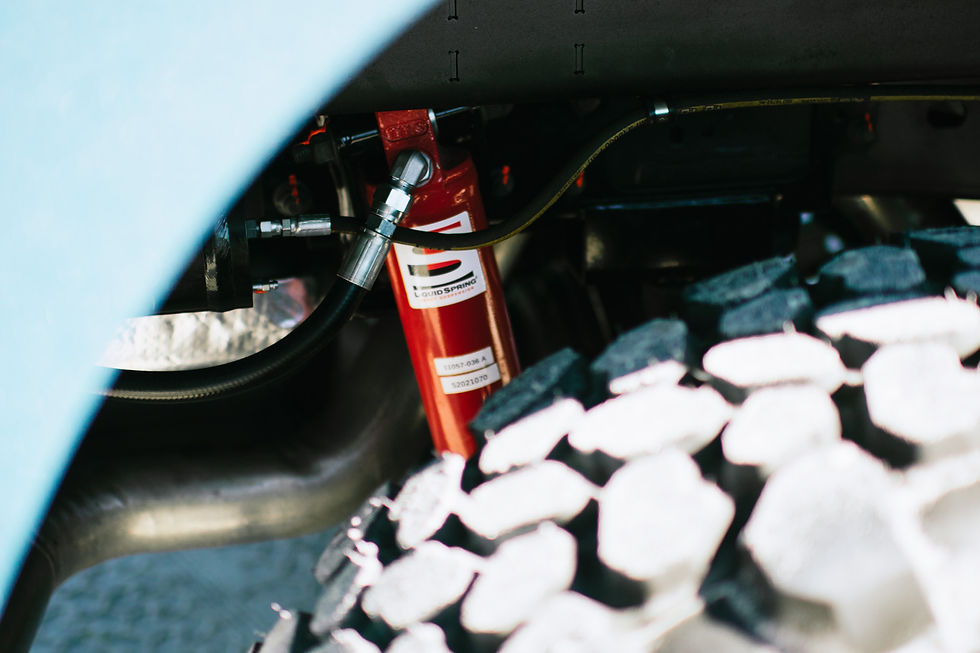
What Happens When the TR27 Goes Off-Road?
The engineering challenge changes dramatically when the pavement disappears.
On uneven terrain, a truck chassis naturally flexes and articulates. If every bit of that movement is transmitted directly into a rigid habitat, loads can become concentrated in portions of the habitat structure.
Over thousands of cycles, repeated stress can contribute to fatigue.
The TR27's polyurethane isolation bushings allow controlled movement between the chassis/subframe system and habitat, helping prevent every twist and impact experienced by the truck from being transferred directly into the living structure.
The result is a mounting system designed for environments ranging from long-distance highway travel to demanding trails and Baja-style terrain.
The Rubber Isolation Membrane: A Second Layer of Protection
The polyurethane bushings aren't working alone.
We also incorporate a rubber membrane between the habitat and subframe.
This additional isolation layer helps absorb road vibration and reduces the transmission of noise, vibration, and harshness into the living space.
Think about what happens during a long trip.
Tiny vibrations occur constantly through the tires, suspension, chassis, and road surface. One vibration isn't particularly important. Thousands upon thousands of them are.
Isolation helps keep those forces from being transferred directly into the habitat.
That means the mounting system isn't designed solely around surviving one dramatic obstacle. It's also designed around the countless smaller forces an expedition vehicle experiences throughout its life.
Why Doesn't the TR27 Use a Pivoting Subframe?
Some expedition trucks use pivoting or multi-point articulating subframes to isolate the habitat from chassis flex.
There are applications where those systems can provide substantial articulation, but 27North chose a different engineering philosophy for the TR27.
We wanted to minimize mechanical complexity while maintaining controlled chassis-to-habitat isolation.
A more complex articulating mounting system can introduce additional joints, pivots, bearings, fasteners, and other components that require inspection and maintenance. Depending on the design, additional movement can also affect body dynamics when traversing repeated uneven obstacles.
For the TR27, we wanted:
Controlled articulation. Highway stability. Fewer mechanical components. Straightforward inspection. And easier serviceability.
That's why we chose an eight-point isolation bushing system rather than a traditional pivoting habitat mount.
Serviceability Was Part of the Design From Day One
Expedition vehicles travel to places where complicated repairs aren't always convenient.
So we asked another question during the development of the TR27:
What happens years later when someone needs to service the truck?
The habitat mounting system was designed so the TR27 shell can be separated by removing eight primary mounting bolts.
Conceptually, the process is much closer to removing an OEM pickup bed than dismantling a complicated articulating habitat mounting system.
That matters to owners, technicians, and eventually the second or third owner of the vehicle.
Good engineering shouldn't only work when the truck leaves the factory.
It should still make sense when someone has to service it years later.
Ram 5500 vs. Ford F-550: Does the Mounting Philosophy Change?
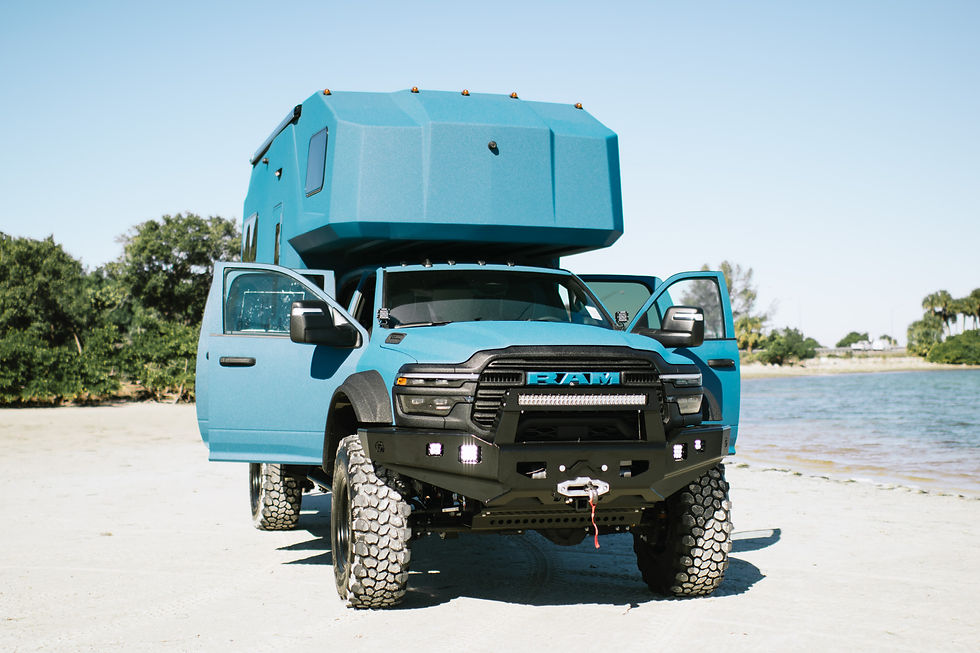
The TR27 can be built around Ram 5500 or Ford F-550 heavy-duty chassis platforms.
Although chassis-specific engineering and mounting components must account for the characteristics of each platform, the fundamental TR27 philosophy remains the same:
Truck chassis → engineered subframe → isolation system → expedition habitat.
The objective is to allow the truck underneath to perform like a truck while protecting the habitat above from unnecessary chassis forces.
Why Not Simply Rigid-Mount the Habitat?
A commercial truck chassis and a large expedition habitat behave differently.
The chassis needs to tolerate twisting and articulation. The habitat is a large enclosed structure containing cabinetry, plumbing, electrical systems, windows, doors, appliances, furniture, and structural connections.
Simply forcing those two structures to behave identically can transmit chassis movement into components that weren't designed to function as suspension members.
Isolation gives the system another way to manage those forces.
Frequently Asked Questions
How is the 27North TR27 habitat attached to the truck?
The TR27 uses an engineered subframe and eight isolation mounting points with polyurethane bushings, along with a rubber isolation membrane between the habitat and subframe.
What chassis does the TR27 use?
The TR27 is engineered around heavy-duty chassis platforms including the Ram 5500 and Ford F-550.
Why does an expedition truck need an isolated habitat?
Heavy-duty truck chassis can flex when traveling across uneven terrain. An isolation system helps reduce the amount of chassis movement, vibration, and impact transferred directly into the habitat.
Does the TR27 use a pivoting subframe?
No. 27North chose an eight-point isolation bushing design rather than a traditional pivoting habitat mounting system. The goal is to balance articulation, highway stability, mechanical simplicity, and serviceability.
Can the TR27 habitat be removed from the chassis?
Yes. The mounting system is designed so the habitat can be disconnected through its eight primary mounting bolts, making chassis/habitat separation considerably simpler than many complex articulating mounting arrangements.
Does the mounting system improve ride comfort?
The isolation bushings and rubber membrane are designed to reduce the transmission of vibration and harshness from the chassis into the habitat. Overall vehicle ride quality also depends on suspension, tires, loading, road conditions, and other factors.
Built for the Highway. Engineered for What Comes After It.
An expedition truck shouldn't force its owner to choose between highway manners and off-road capability.
That's the philosophy behind the TR27 mounting system.
Eight isolation bushings help distribute loads and stabilize the habitat on the highway. Polyurethane isolation allows controlled movement when the chassis articulates off-road. A rubber membrane further reduces vibration and harshness. And a mechanically straightforward mounting design keeps future serviceability in mind.
Because the best expedition vehicle isn't simply the one capable of reaching a remote destination.
It's the one engineered to get there, live there, and get you home again.
27North TR27 — Built to go. Built to last.


Comments